
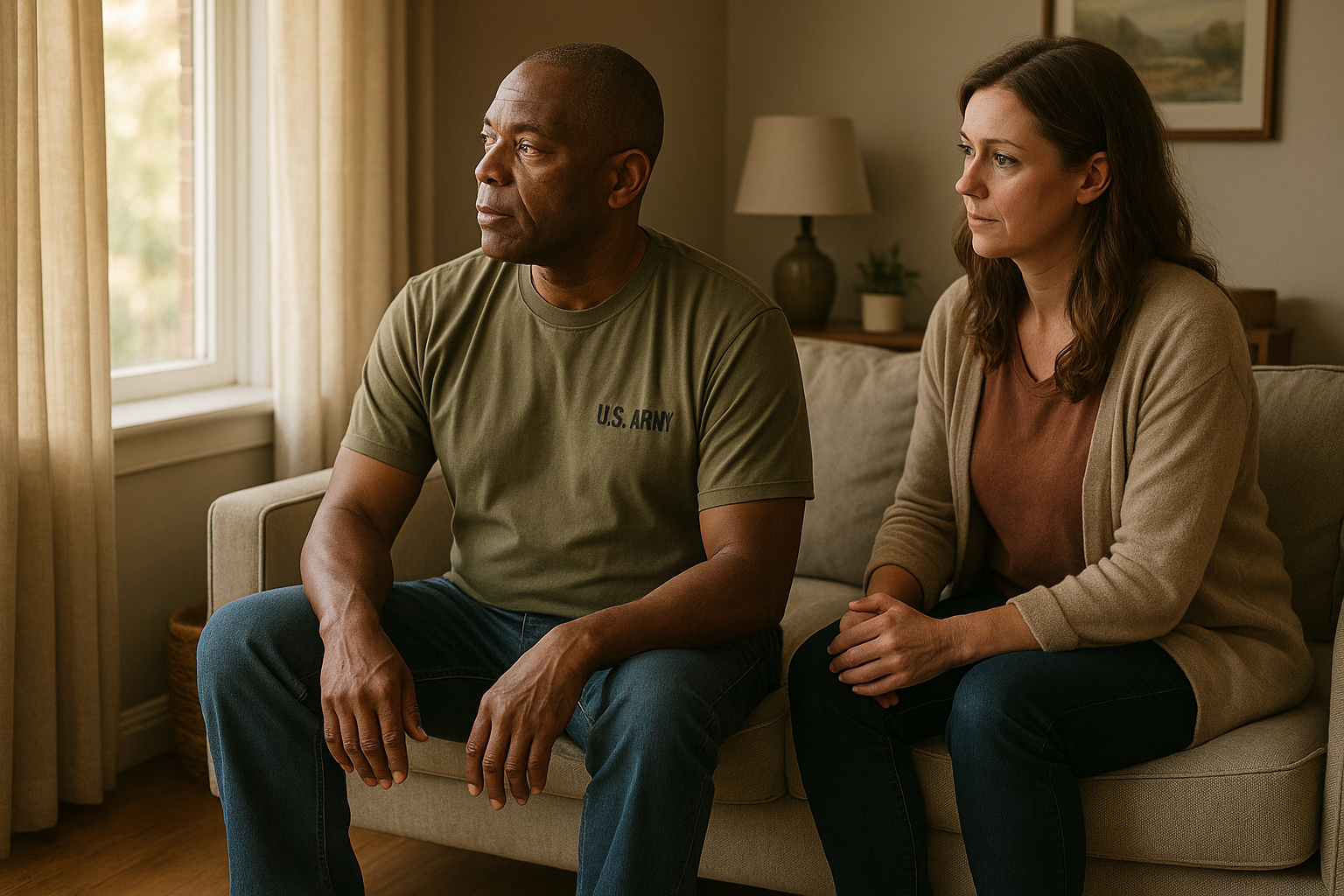
Hypervigilance is a state of being unusually alert for danger. After combat or another traumatic experience, your brain and body may continue scanning people, sounds, spaces, and situations as if a threat could appear at any moment. This can lead to jumpiness, irritability, poor sleep, trouble concentrating, and exhaustion. Hypervigilance is a trauma response, not a personal failure, but it can become a serious problem when it makes ordinary life feel unsafe. Helpful steps may include grounding, improving sleep routines, reducing triggers that intensify arousal, connecting with trusted people, and seeking qualified mental health care when symptoms persist or interfere with life.
What does hypervigilance feel like?
Hypervigilance can feel like your internal alarm system is always switched on. You may notice every movement in a room, sit with your back to a wall, study exits, or react strongly to a door slamming. You might track other people’s hands, voices, facial expressions, or positions without consciously choosing to do so.
For a combat Veteran, this response may have once helped support survival in a dangerous environment. The same habits can continue after returning home, even when the current setting is relatively safe. Service members in an active or recently changed environment may also experience this response. Families and caregivers may notice the effects before the person experiencing them has words for what is happening.
Being aware of your surroundings is not automatically a problem. Alertness can be useful when driving, caring for children, working, or responding to a real concern. Hypervigilance becomes more concerning when the level of alertness is far greater than the situation requires, feels impossible to turn off, or causes distress, conflict, avoidance, or exhaustion.
What are common signs and symptoms?
Hypervigilance can affect the body, thoughts, emotions, behavior, and relationships. Not everyone experiences the same pattern, and these signs do not by themselves diagnose PTSD or any other condition.
Changes in attention and thinking
- Scanning a room repeatedly for exits, unusual sounds, or possible threats
- Having difficulty relaxing because your mind keeps looking for what could go wrong
- Assuming an unfamiliar person, vehicle, sound, or situation may be dangerous
- Finding it hard to focus on conversations, work, reading, or entertainment
- Feeling distracted by small changes in the environment
- Replaying possible dangers or planning how to respond to them
Body and sensory reactions
- Being easily startled by noises, touch, movement, or someone entering a room
- Muscle tension, clenched teeth, a tight jaw, or a racing heart
- Sweating, shallow breathing, trembling, stomach discomfort, or restlessness
- Difficulty falling asleep, staying asleep, or returning to sleep after waking
- Feeling worn out but unable to settle down
- Strong reactions to crowds, darkness, traffic, fireworks, helicopters, or sudden changes
Emotional and behavioral changes
- Irritability, anger, impatience, or a shorter temper than usual
- A strong need to control schedules, seating, routes, doors, or surroundings
- Avoiding stores, restaurants, public events, travel, or unfamiliar places
- Sitting in a particular position so you can see the room or leave quickly
- Checking locks, windows, children, equipment, or messages repeatedly
- Pulling away from family and friends because social contact feels demanding
Some people describe hypervigilance as being on guard, wired, keyed up, or unable to shut off. Others mainly notice the consequences, such as poor sleep, arguments, headaches, or missing activities they used to enjoy.
Why can trauma cause hypervigilance?
Trauma can change how the nervous system evaluates safety. When the brain has learned that danger can appear suddenly, it may give priority to detecting threats. Sounds, smells, places, body sensations, or situations that resemble past danger can activate this alarm response, sometimes before you consciously recognize the connection.
This does not mean your brain is broken. It means a protective system may be staying active after the original danger has passed. The system is designed to respond quickly, so it may sometimes produce a false alarm. A crowded grocery store, a car backfiring, a news report, or a person approaching from behind may trigger a reaction even when you understand logically that you are not back in the past.
Hypervigilance can occur with PTSD, but it can also occur after other stressful experiences or alongside anxiety, depression, sleep problems, pain, traumatic brain injury, substance use, or medical concerns. Only a qualified professional can assess what may be contributing to your symptoms. You do not need to label yourself or prove that your experience is serious before asking for help.
How can hypervigilance affect everyday life?
Constant alertness uses energy. Over time, it may leave you physically tired while your mind remains active. Lack of sleep can then make startle responses, irritability, concentration problems, and emotional reactions stronger. This can create a cycle: you feel unsafe, monitor your environment more intensely, sleep poorly, and become even more reactive the next day.
Relationships may also be affected. A partner may interpret checking, silence, or a quick temper as distrust or rejection. A Veteran may feel misunderstood or ashamed and withdraw further. At work or school, concentration and patience may be reduced. Driving, shopping, attending appointments, or spending time in public may require so much planning that ordinary tasks become exhausting.
These effects are real, but they are not permanent proof that you cannot have a meaningful life. With support and appropriate care, many people learn to recognize alarm signals, respond to triggers differently, and regain activities that matter to them.
What can help calm hypervigilance?
There is no single technique that works for everyone. The goal is not to force yourself to stop noticing danger or to deny what happened. The goal is to help your nervous system distinguish present-day safety from past threat, one small step at a time.
Start with present-moment grounding
When you notice your alarm rising, orient yourself to the current moment. Slowly look around and name several things you can see. Notice the surface supporting your feet, the temperature of the air, and the sounds that are actually present. You can say quietly: I am at home, it is daytime, and I am safe enough in this moment. Use words that are accurate and believable to you.
Grounding is not pretending that nothing bad can ever happen. It is reminding your brain to include current information instead of relying only on old danger signals. If focusing on your body increases distress, keep your eyes open and use external details such as colors, shapes, or familiar objects.
Use slower breathing without forcing it
Try breathing in gently and making the exhale a little longer than the inhale. For example, breathe in comfortably for a count of three and out for a count of four. Repeat for several cycles without straining or holding your breath. If counting makes you more anxious, simply relax your shoulders and let your breathing become quieter and slower.
Breathing exercises may reduce physical arousal for some people, but they are not a test of willpower. Stop or switch approaches if you feel dizzy, trapped, or more distressed. A trauma-informed clinician can help you find grounding skills that fit your experience.
Create a practical safety plan for ordinary settings
Planning can be useful when it supports participation rather than expanding fear. Before an appointment or gathering, identify a reasonable route, a place to take a break, and one trusted person you can contact. Then try to avoid repeated checking after you have completed the plan. A simple plan might be enough: park in a familiar area, sit where you are comfortable, and give yourself permission to step outside for a few minutes.
The purpose is to build confidence, not to guarantee that every detail will be controlled. If planning becomes complicated, repetitive, or prevents you from leaving home, discuss it with a professional.
Build predictable routines
Regular meals, movement, appointments, household tasks, and sleep and wake times can give your nervous system steady signals. Choose small routines you can maintain. A short walk, a shower, time with a pet, or ten minutes of quiet music may be more useful than an ambitious plan that becomes another source of pressure.
For sleep, keep the bedroom as comfortable and predictable as possible. Reduce stimulating activities close to bedtime, and write down worries or next-day tasks earlier in the evening. If nightmares or severe sleep disruption continue, seek professional guidance. Do not change prescribed medication on your own; talk with the prescribing clinician about concerns or side effects.
Track patterns without judging yourself
For a week or two, you might note when hypervigilance increases, what was happening beforehand, how intense it felt, and what helped. Possible factors include poor sleep, pain, crowds, conflict, anniversaries, news coverage, alcohol, caffeine, or certain sounds. Keep the record brief. The purpose is to identify patterns and share useful information with a clinician, not to monitor yourself constantly.
What may make hypervigilance worse?
Some responses provide short-term relief but strengthen the alarm cycle over time. Avoiding every crowded place, checking locks for long periods, demanding constant reassurance, or staying isolated may make the world feel more dangerous and shrink your daily life. Avoidance is understandable, especially after trauma, but it can become a barrier to recovery when it controls most choices.
Alcohol, cannabis, and other substances may seem to quiet the nervous system temporarily, yet they can worsen sleep, mood, irritability, memory, or anxiety. Excess caffeine, nicotine, energy drinks, and repeated exposure to upsetting news can also increase physical arousal. This is not a reason for shame. If substances are part of how you cope, confidential support is available, and a qualified professional can help you consider safer options.
Arguments during moments of high activation can escalate quickly. If possible, pause the conversation, create physical space, and agree on a time to return to it. Taking a break is different from abandoning the relationship. It can protect everyone while the alarm response settles.
When should you consider professional help?
Consider speaking with a qualified mental health professional if hypervigilance lasts, keeps returning, or interferes with sleep, work, relationships, driving, parenting, or activities you value. Professional support is also appropriate if you are avoiding more and more situations, relying on alcohol or other substances, experiencing panic, feeling persistently hopeless, or having thoughts of harming yourself or someone else.
A primary care clinician, VA or community mental health professional, military treatment provider, chaplain, or trusted referral source can help you find an appropriate evaluation. You can ask whether the provider has experience with Veterans, combat trauma, PTSD, moral injury, traumatic brain injury, or military culture. You can also bring a trusted person to an appointment if that makes it easier to explain what is happening.
Evidence-based PTSD treatments may include trauma-focused cognitive behavioral therapies such as Cognitive Processing Therapy or Prolonged Exposure, and other approaches such as Eye Movement Desensitization and Reprocessing when provided by a qualified clinician. Treatment should be collaborative and paced with attention to your safety and needs. You do not have to describe every detail of your trauma in the first conversation to begin receiving help.
Related topics that may be useful to explore include PTSD triggers, grounding techniques, and sleep problems after trauma. These links can connect you with additional education as you learn what affects your alertness.
How can loved ones respond?
Family members and caregivers may feel confused when a Veteran reacts strongly to an ordinary sound or seems unable to relax. Try to see the behavior as a possible alarm response rather than intentional anger or rejection. A calm voice, extra space, and a clear explanation of what is happening can help.
- Ask, What would help you feel more settled right now? rather than assuming.
- Give advance notice before entering a room, touching the person, changing plans, or inviting guests.
- Keep your own tone steady and avoid crowding someone who is overwhelmed.
- Agree on a simple signal or phrase that means a break is needed.
- Encourage professional support without demanding a diagnosis or forcing disclosure.
- Set respectful boundaries around threats, yelling, or unsafe behavior.
Support does not mean accepting abuse or taking responsibility for another person’s recovery. If anyone is in danger, leave the situation and call for emergency help. Loved ones also need rest, support, and their own space to talk with a counselor or trusted support person.
Can faith or spirituality help?
For some Veterans, faith, spirituality, prayer, meditation, connection with nature, or service to others can provide meaning, community, and a sense of grounding. A trusted chaplain or spiritual leader may offer support that respects your beliefs, including uncertainty or spiritual struggle. Faith and spiritual practices can complement mental health care; they do not replace evaluation or evidence-based treatment. Choose practices that feel safe and supportive rather than those that increase guilt or pressure.
When to get immediate help
If you may act on thoughts of suicide, self-harm, or harming someone else, or if you cannot keep yourself or another person safe, get help now. Veterans Crisis Line: Dial 988 then Press 1, text 838255, or use VeteransCrisisLine.net chat. Call 911 for immediate danger.
If possible, move away from weapons, medications, alcohol, or other means of harm and ask a trusted person to stay with you while help is contacted. If you are helping someone else and danger is immediate, prioritize safety and follow the directions of emergency responders.
Moving forward with hypervigilance
Hypervigilance is a protective response that can remain active after trauma, but you are not required to organize your entire life around the alarm. Start with one manageable change: practice grounding once a day, protect a regular sleep routine, reduce one factor that increases arousal, or schedule an appointment with a qualified provider. Notice progress in small terms, such as recovering more quickly after a startle, staying at an event a few minutes longer, or having one calmer conversation.
You deserve support that respects your service, your history, and the ways trauma has affected you. Asking for help is not weakness. It is a practical step toward feeling more present, connected, and able to choose how you respond.
Trusted PTSD & Veteran Support Resources
This article is educational and is not a diagnosis or a substitute for professional care.
- VA National Center for PTSD
- VA PTSD Self-Help and Coping Resources
- Veterans Crisis Line — Dial 988 then Press 1; text 838255
0 Comments